Colombia, 2026. Medellín is a place that has inspired songs such as “Me voy para Medellín” by El Combo de las Estrellas, “Medellín” by Madonna, and even “Medallo City” by Maluma, all of which praise its natural beauty, culture, and nightlife. However, the fantasy conveyed by the international music industry disappears just a few streets beyond the commercial and touristy areas, where the history of this city also bears the scent of abandonment, dispossession, accumulation, and resistance.
This city, like many other Latin American cities, has been fragmented by armed conflicts and the excessive consumption of the Global North, which has imposed its models of occupation and marketplace, such as the drug trade, permeating violence, fracturing social structures, and uprooting thousands of inhabitants from their territories, homes, and loved ones.
Despite the pain and collective trauma, Medellín also manifests the great strength of the people who have lived there for generations, migrants who work honourably, and the critical tenacity of the few institutions that remain committed to plurality, such as the University of Antioquia. Each of them, with their creativity and driving force, strive to move forward and bear faithful witness to Colombia’s dignity.
A clear example of this is the work of muralist and sociologist Eskibel, who since the age of eleven has been expanding his sensibility through urban art. His urban messages deal with memory and territoriality, collective desires, social milestones, and above all, the courage that every ethnic community brings. His work’s purpose is to occupy spaces to represent and challenge the unnamed majority, far from imported aesthetic standards and folkorism.
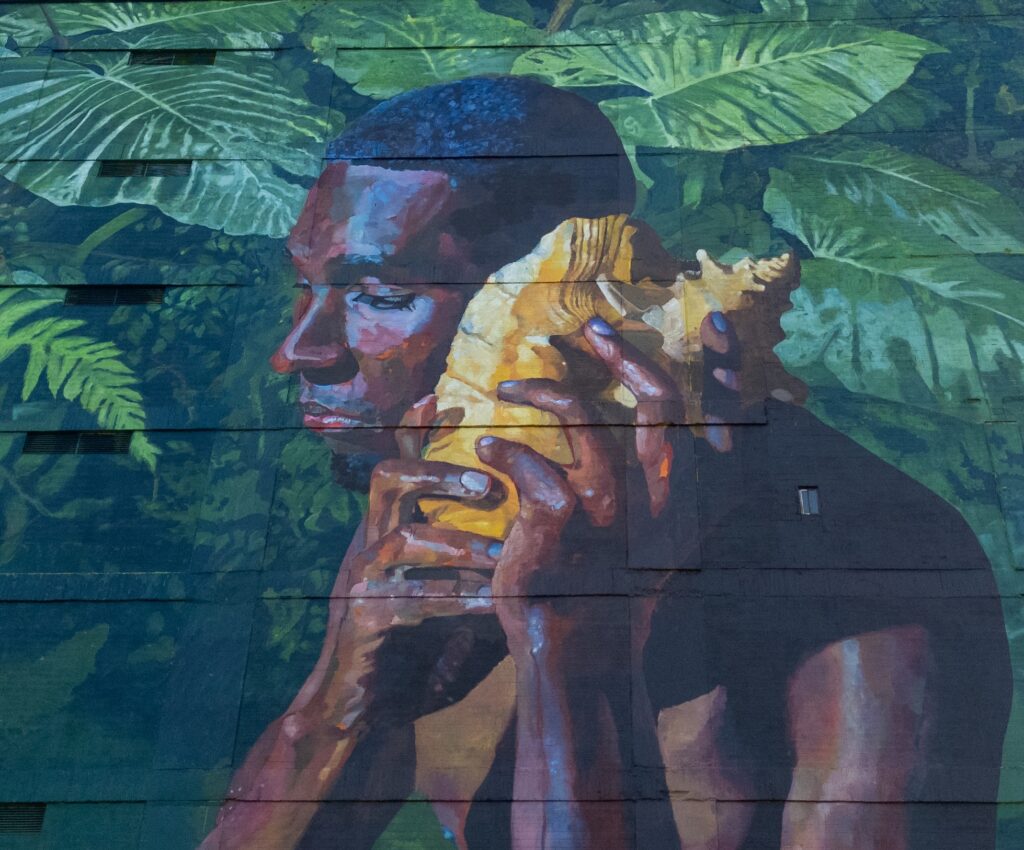
Eski, his preferred name, envisions building memory and social awareness by also offering drawing and painting workshops for children and young people as part of the peace-building process. One of their most recent iconic works clearly illustrates this vision:
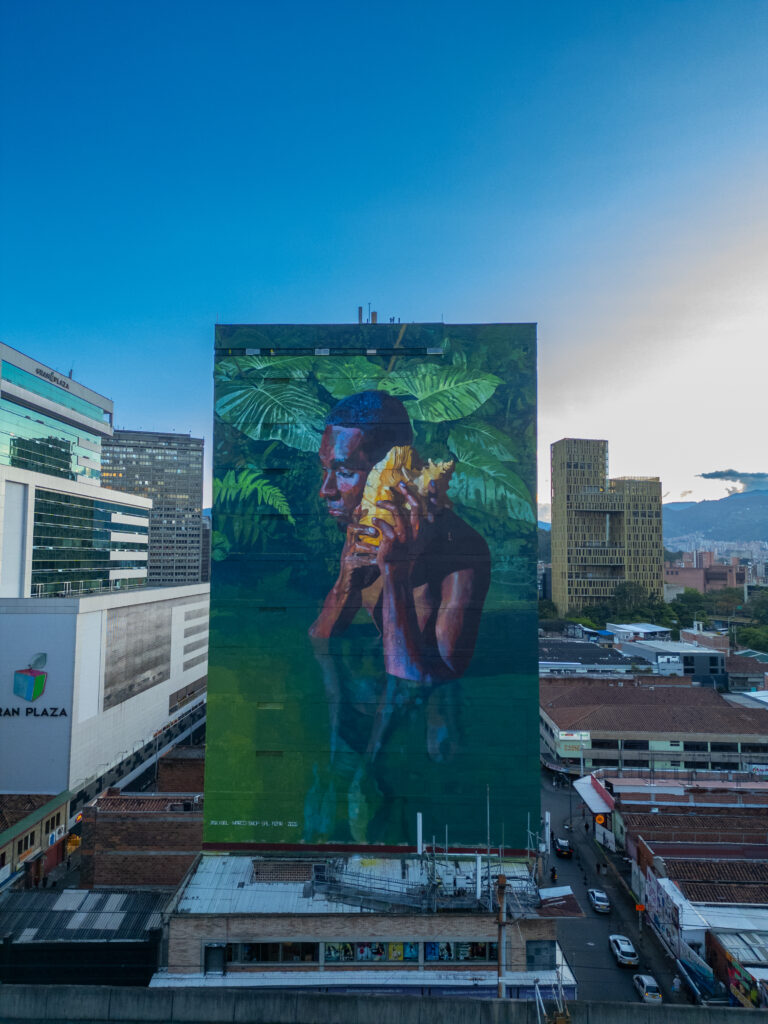
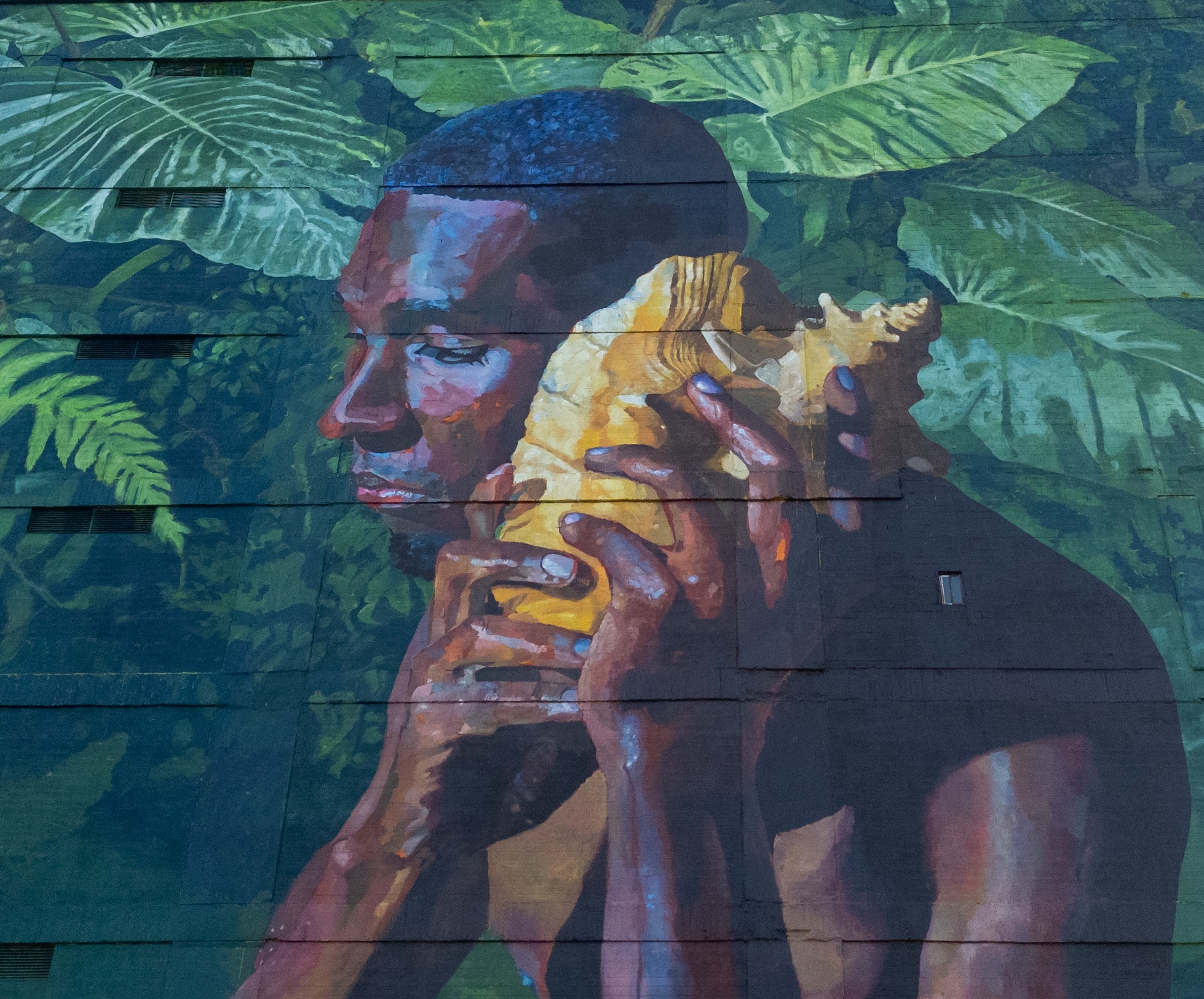
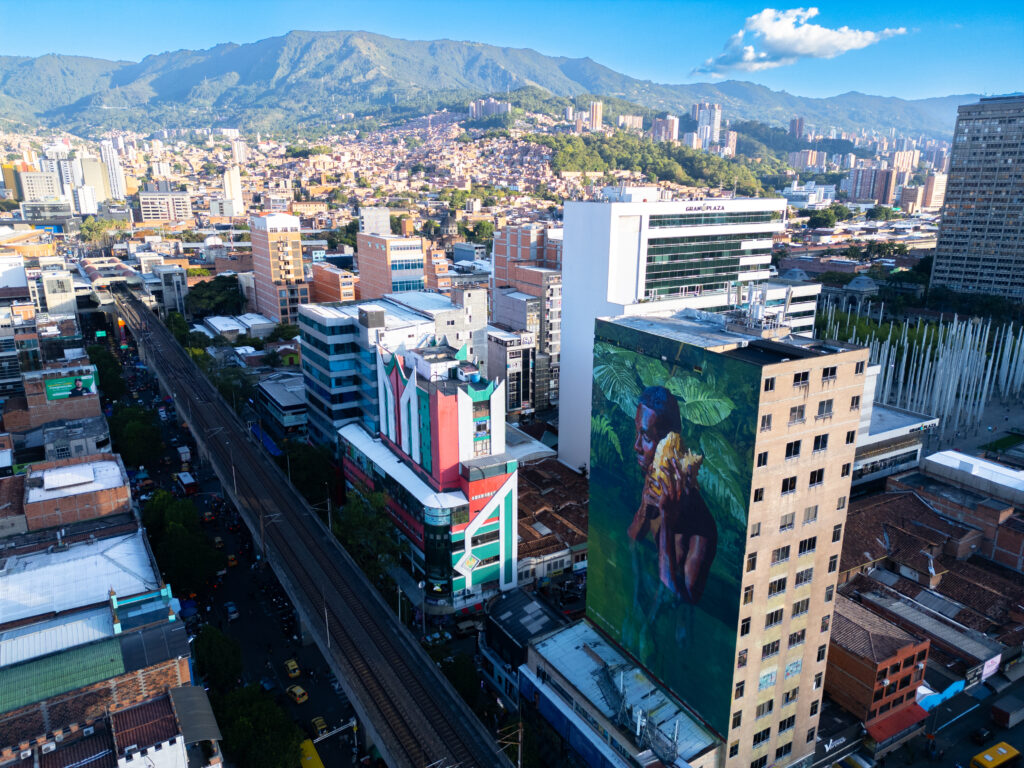
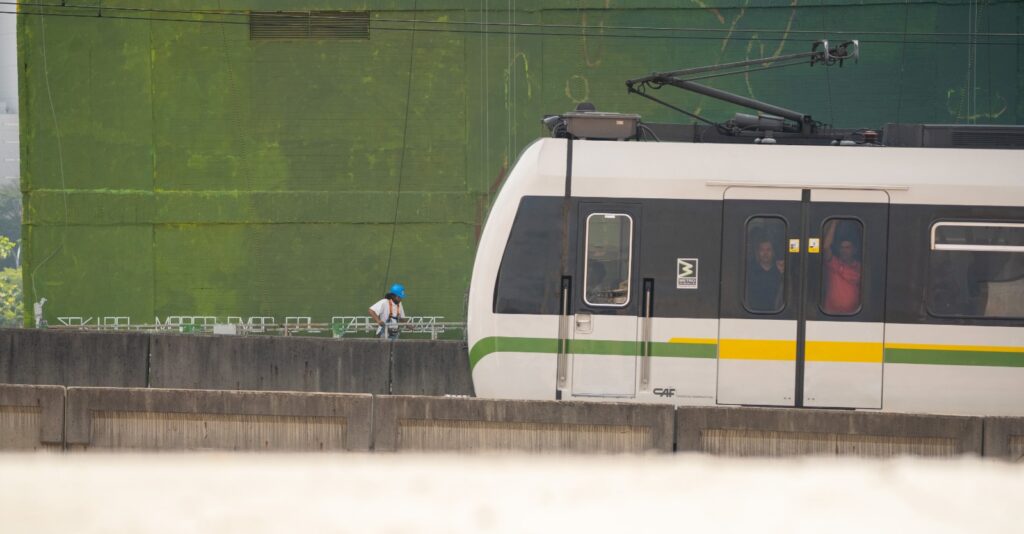
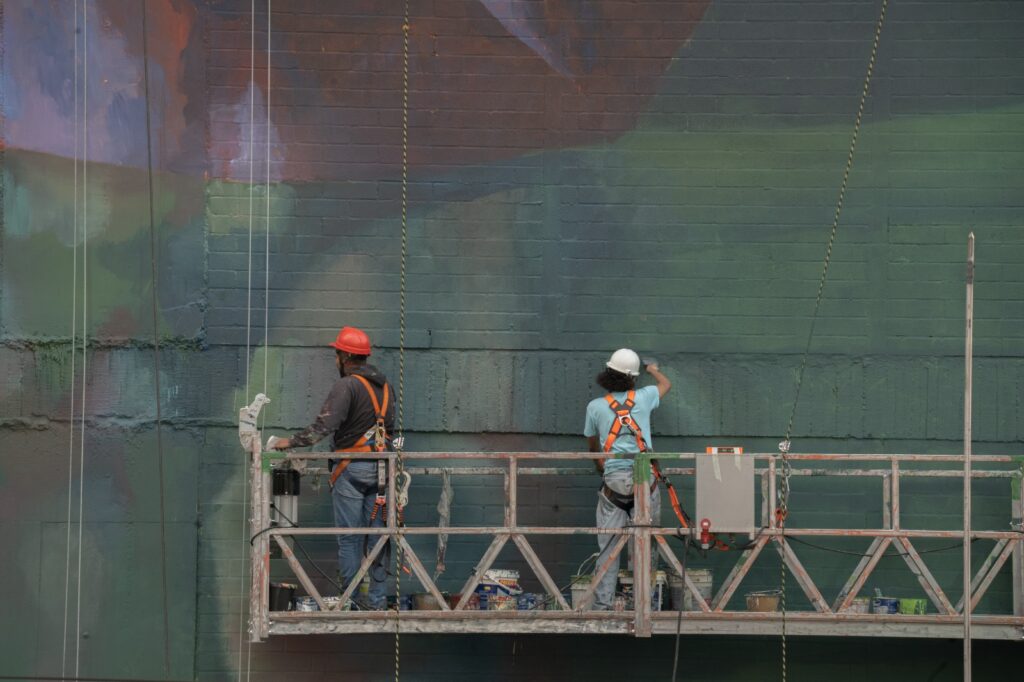
This mural is located at Cra. 54 #45 A 38 P 1, La Candelaria, Medellín, at the intersection of 54th Street and 45th Street A, in the commercial district known as El Hueco in the heart of Medellín, specifically on the building of the Mundo Mágico toy store. It is considered one of the largest murals in Colombia, using classic mural techniques, which is unprecedented on a wall of these proportions. Additionally, it is the first oversized mural in the city to represent an Afro-Colombian person.
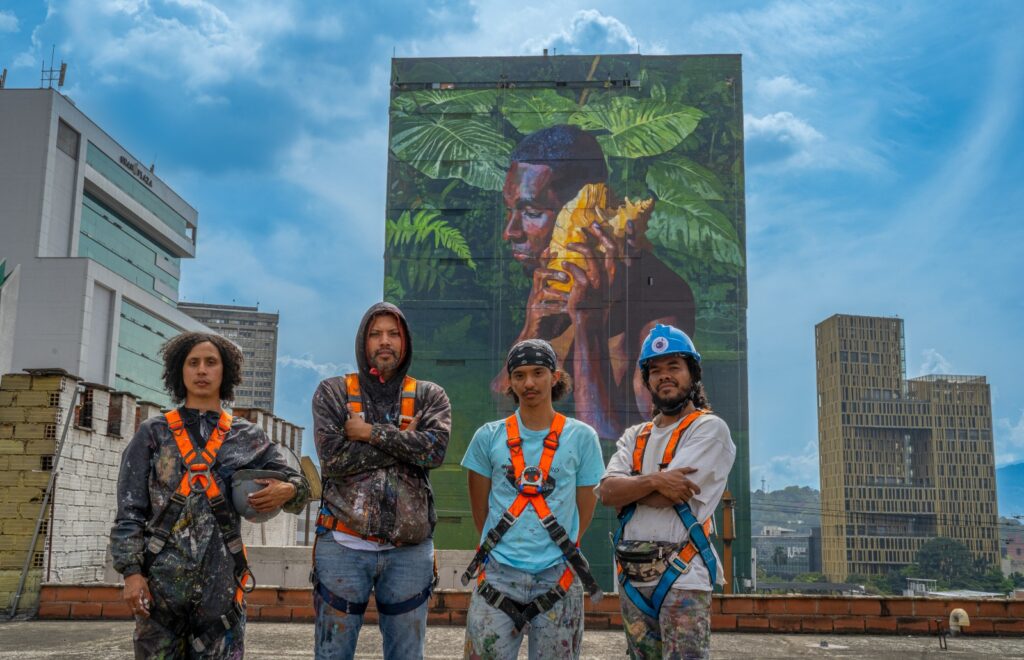
When asked about the painting’s underlying message, Eski mentioned the importance of representing the city’s diversity, particularly in a space where white ideology is predominant. Thus, depicting a young Afro-Colombian man has several interesting connotations worth noting.
To begin with, racism is a system that actively operates in Latin American cities, expressed through policies—public, economic, and cultural—that promote inequality and discrimination against non-hegemonic bodies. These are rooted in modernity (as a global civilizing project) and the institutionalization of “valid” and primarily Eurocentric ways of being, existing, and thinking. Indigenous and Black peoples have been subalternized and made invisible for centuries this way.
Although throughout history we’ve seen social change, criticism, and struggles for the recognition and self-determination of ethnic communities, racism is a latent wound that has been internalized after centuries of constant repetition and cruel indoctrination, to the point where it becomes normalized in everyday life. Hostile comments, attitudes, and discriminatory practices often go unnoticed.
Medellín is no exception. The city’s official communications, representations, and narratives often exclude Black and Indigenous populations, despite the fact that nearly 236,000 Afro-Colombians live there, according to the organization Manos Visibles.
Eski explained that in symbolic terms racism is also a way of relating to the other. That is why showcasing the presence of the Afro-Colombian community on a large scale in a public space sends a powerful message: Medellín is also Black.
The diversity of skin tones used to paint this young man’s skin proclaims that no two people on this planet are the same color and, therefore, there is no such thing as human homogeneity, debunking racial myths. It is asking we understand ourselves as fully diverse, as diverse as life itself, because diversity is natural. This understanding integrates the body with its Earthly habitat, abundant in its shapes, colors, textures, and vegetation.
The act of deep listening
By holding one’s ear to a conch shell, we listen to the polyphony of the sea and feel transported to that ancient and mysterious voice whose irrepressible power is held in a whisper, as if it were a secret, soothing us with its gentle breath. It evokes the innocent sensation of being light as foam, dissolving into the sand.
It is a reminder of how, at times, the noise of capitalist greed stops, allowing us to pay attention to the truthful voices that come from the deep within the Earth.
This work also echoes the powerful and profound message etched in the streets and everyday life of Colombia: “Las cuchas tienen razón” (The cuchas are right), referring to the mothers demanding justice for their missing and buried children in San Javier after the represssion during Operation Orion in Medellín in 2002. Perpetrated by the military and paramilitary groups , this painful event still has repercussions on the community, showing the armed conflict is not yet fully over.
We listen so as not to forget, to name those who have not been found and those who have been murdered, to give space to the stories that the mainstream media does not tell. We listen because shared pain brings some relief. In times of the deafening noise, “deep listening is a channel for peacebuilding, it is an act of awareness and appreciation”, explained Eski.
When we listen to each other, we must face the other person, who is also a part of “ourselves” in dialogue. An open, sensitive, and compassionate horizon emerges, giving rise to resistance, understanding, and healing. Listening is vital for community mental and spiritual health, especially in contexts where extreme violence has been used to silence people’s truths.
“We must create a healthy coexistence between images and words.”
“Images tend to be more intuitive, concrete, relatable, and factual. The artist’s skill lies in connecting and integrating the world’s stories, texts, and personal reflections into a sensitive image that communicates. In that interval, it is important to engage with the population, take the gray spaces and fill them with stories and color to create and imagine possibilities for understanding and getting to know each other,” Eski shared.
From this perspective, muralism becomes a tool for epistemic justice by seeking to take art out of privileged spaces and tell the territory’s stories, drawing on the wisdom of the people, cities, and peripheries, and claiming its rightful place in the cultural landscape. Likewise, it centers the question: What is the meaning of making art? Even more so when the artist has experienced firsthand the ravages of the system. The answer goes hand-in-hand with a critical pedagogy of tenderness that helps us confront difficulties and cultivate hope. Therein art regains its meaning and purpose.
What is the meaning of making art? The answer goes hand-in-hand with a critical pedagogy of tenderness that helps us confront difficulties and cultivate hope.
The New Era of Latinamerican Muralism
Latin American muralism is committed to celebrating collective rather than individualistic achievements. Through the sum of many efforts, it gradually generates synergy and encourages us to explore the boundaries between memory, imagination, narrative, and the artist’s style, revealing a possible horizon where art becomes a tool for the community.
In Colombia, contemporary muralism has an impressive track record and in recent years has become a point of reference, not only for its quality and sensitivity, but also for the courage with which its artists denounce the abuse of power. They promote with dignified anger the memory and reinterpretation of social processes in the streets.
“We play with colors and symbols, and enable community interactions, often encouraging people to participate and take ownership, although we can’t always predict its impact. That’s why it’s important to be very clear about the intention behind the mural,” Eski said.
At this point in our conversation with Eski, we realized that this new era of Latin American muralism is marked by an expansion of community, managed autonomously, collectively, and in solidarity through festivals, gatherings, and shared experiences, whose scope is both national and international. One component of this is that we share a historical matrix of resistance and love for our territories, and Latin American muralism today is yet another expression of this.
We share a historical matrix of resistance and love for our territories, and Latin American muralism today is yet another expression of this.
